Pitrat on AI Research (1997)
Building Solutions to Understand Problems
While preparing my HDR mémoire in 2013, I discovered Jacques Pitrat’s 1997 paper “Comment faire de la recherche en intelligence artificielle” buried in the LAFORIA archives (now LIP6). It was a .doc file from another era of AI research. I’m grateful I saved a copy—it seems lost to the internet now, yet its insights still feel relevant to me.
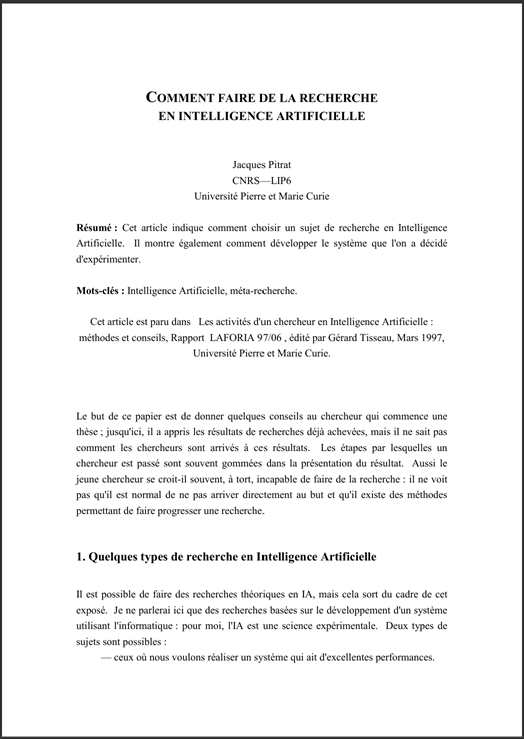
What resonated most in Pitrat’s paper was how he articulated something I was experiencing during my work at the intersection of AI and design science: AI research inherently serves two distinct purposes. We advance AI as a technical discipline, yes—but we also use AI experimentation as a method to illuminate poorly-understood problem domains.
This dual nature matters today as AI transforms organizations, cultures, and cognition across many sectors. I find myself asking not just “does this AI work?” but “how does deploying this AI change human practice?”
This memo summarizes Pitrat’s framework, then offers my perspective on its relevance in 2026.
Two Types of AI Research
Pitrat identifies two complementary research approaches. The first focuses on building systems with excellent real-world performance: demonstrating that AI delivers practical value today. These projects force researchers to confront real problems in full complexity.
The second type tackles very difficult problems to gain conceptual clarity rather than immediate performance. Here, what matters is whether the system helps researchers understand the problem better, reveals unexpected difficulties, or demonstrates feasibility.
Pitrat’s key recommendation to pick a PhD topic? Build two systems sequentially.
The first familiarizes you with the domain and its real difficulties. After several months reflecting and writing, build the second system incorporating those lessons. This is where genuinely new AI ideas emerge.
His methodological wisdom is practical: start implementing early, since insights come from experimentation. Aim to “traverse” the system quickly by producing one complete result end-to-end. Feed your unconscious by reading widely and taking breaks. Test viability early by solving problems by hand. Learn from both failures and unexpected successes.
Back in 1997, Pitrat wrote for doctoral students navigating PhD grants. He couldn’t have foreseen how prescient his work would become thirty years later, as AI deployment reaches every corner of the economy.
Why This Matters Now
In my opinion, Pitrat’s two types of research remain relevant today, though their balance has shifted dramatically. We’re seeing a proliferation of Type 1 research: building performant AI systems across many domains. ChatGPT, Copilot, Claude, content generation tools—companies are racing to demonstrate practical AI value.
This proliferation increases importance of Type 2 research: building systems to gain conceptual clarity.
AI is reshaping workflows, redefining roles, and altering decision-making structures in organizations. It’s shifting what we consider expertise, how we learn, what we value as skills. It’s changing our relationship to memory, creativity, and problem-solving.
As AI pervades organizations, we need research that illuminates how AI transforms human practice. Not just “does this chatbot answer questions correctly?” but “how does having this chatbot change how people learn, think, and collaborate?”
To understand this transformation, we need research methods that embrace action: build and deploy to learn, evolve hypotheses as deployment reveals unexpected effects, bridge technical performance with socio-organizational impact, maintain rigor while accepting that problem spaces shift as we work.
Pitrat’s 1997 framework offers a useful foundation. The work now is applying it in domains where the “problem” isn’t just technical but human and organizational, where deployment itself changes what we’re studying.
References
Pitrat, J. (1997). “Comment faire de la recherche en Intelligence Artificielle,” in Les activités d’un chercheur en Intelligence Artificielle : méthodes et conseils, Rapport LAFORIA 97/06, Université Pierre et Marie Curie.